Clarity through collaboration
Setting Direction Through Design Methods
In just two weeks, ten key collaborators came together in focused Mural sessions to cut through complexity, align on priorities, and shape a clear direction for what to build next.
July 2023

Summary
Over the course of a couple weeks, 10 participants committed to a series of focused one-hour Mural sessions. These sessions provided a structured yet collaborative space where individuals from different roles came together to exchange perspectives, share challenges, and identify common priorities. By working collectively, the group was able to cut through complex problems and begin shaping a clear direction for future solutions.
Involvement
-
2 Product Designers
-
Product Manager
-
Stakeholder Team
-
Architect
-
Lead Development Team
Showcase Type
Research: Problem Tree Analysis & Prioritization
Role
Lead Designer & Facilitator

The Challenge
Following a year of research and internal cleanup, the real challenge wasn’t just fixing surface issues, but exposing root causes and translating goals into tangible impact.
My Contribution
-
Planned and defined the research strategy
-
Facilitated workshop
Facilitated user interviews prior to session
Leveraged service blueprint + feedback loop
Impact of Reframing
The power of reframing lies in shifting perspective—moving from seeing challenges as isolated issues to viewing them as opportunities for deeper impact. When problems are reframed, teams can cut through complexity, uncover root causes, and connect challenges that might otherwise appear unrelated. This not only sparks more creative solutions but also ensures that efforts target the areas with the greatest influence. Reframing is often the turning point that transforms scattered pain points and opporitunities into clear, actionable focus, making it a powerful driver of meaningful change.
Zeroed in on Opportunities
Through reviewing past work, participants identified and prioritized a handful of critical challenges
Increased Alignment
Joint effort led stakeholders to align on critical areas of focus.
Activated Opportunities
Collaboration & Iteration
_edited.jpg)
Collaboration
& Iteration
Addressing root-cause problems can be complex, so I applied the "How Might We" approach to create space for participants to think openly — concentrating on exploring problem areas rather than rushing toward solutions.
Prioritization
Although solutions hadn’t been defined yet, having too many problem statements risked leaving the team stuck. To move forward, I introduced a prioritization matrix framed around ‘How might we…’ questions. This allowed the team to imagine what solving each problem could require and, in turn, helped them identify which problems were most important to truly address first.

_edited.jpg)
LUMA Approach
Facilitated the LUMA Problem Tree Analysis to guide the team beyond surface-level issues and uncover the underlying root causes driving challenges. This method dives much deeper into parts on the causal (feedback) loop and service blueprint. By mapping problems visually, participants were able to see how symptoms, causes, and consequences connected across e-commerce replenishment. This process not only encouraged critical thinking but also built a shared understanding of where the real leverage points existed. With this clarity, we transitioned into reframing the insights as ‘How Might We’ questions and used a prioritization matrix to evaluate impact and feasibility. This structured flow helped the team move from feeling overwhelmed by many problem statements to confidently focusing on the most meaningful opportunities
.png)

Problem Tree Analysis
.png)
Groundwork
As lead for the workshop and research strategy, I partnered with another product designer to conduct interviews and synthesize a year’s worth of insights. Together we presented the findings in a service blueprint, a causal feedback loop diagram, and reporting document.
These artifacts brought diverse buyer perspectives to light, revealing how processes, tools, and roles interconnected across the e-commerce landscape. Visualizing the ecosystem as a living network of causes and effects helped stakeholders see beyond isolated problems, uncover hidden complexities, and align on where to focus and why it mattered.
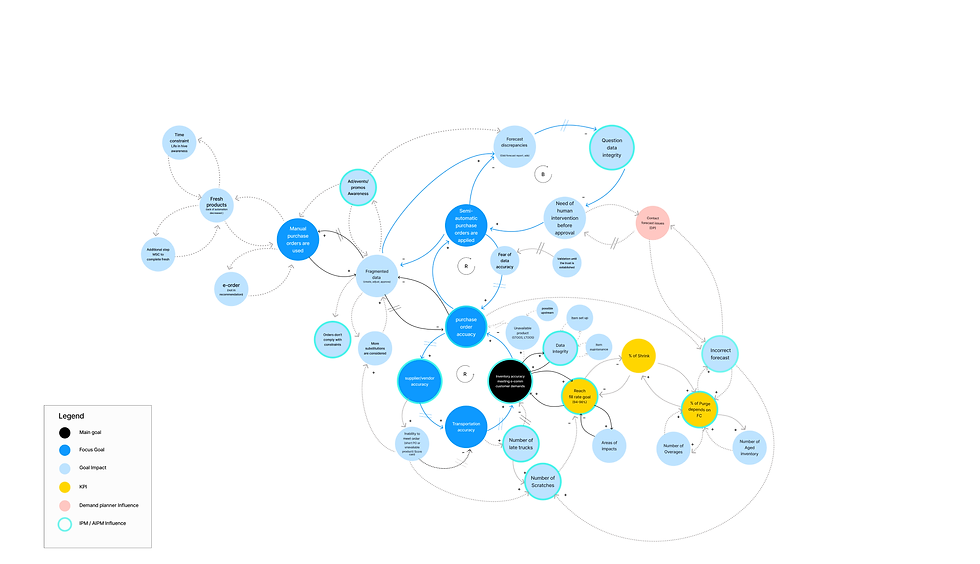
Causal (Feedback) Loop- Figma
Mapping the cause-and-effect relationships across the buyer’s world—and how these dynamics influence one another—provides a truer picture of the experience. While journey maps offer valuable insight, real life is rarely linear. This approach reveals how relationships intersect and impact each other, highlighting areas that warrant deeper exploration and uncovering opportunities that may otherwise be missed.

Service Blueprint- Mural
This was approached using a jobs-to-be-done format in mind to illustrate the layered segmentation of how an e-commerce buyer performs their work. We also incorporated layers representing different buyer types, showing how each role influences various points within the journey.

Reporting - Mural
Through interviews to validate and update the blueprint, we also conducted activities to map all major external reporting tools in use. This process revealed which tools were most relied upon, where gaps existed, and provided insight to help prioritize long-term solutions for these workarounds.

Reflection
Navigating Complexity with Purpose
The transformation was not just about frameworks or tools, but about people—about listening, assessing, and responding. What made this journey exceptional was the integration of service design, UX design, and research into a seamless direction. By integrating the causal loop with our blueprint and incorporating user workaround reporting as part of the current process, we established a framework that supports responsive decision-making based on comprehensive understanding.
If I could change anything about this process, it would be to have had the opportunity to participate from the outset—to weave service design methods into the earliest stages and gain an even richer understanding of the business context and user needs. Nevertheless, the collaborative, research-driven approach I led took delivered clarity, alignment, and a pathway to meaningful, long-term progress.